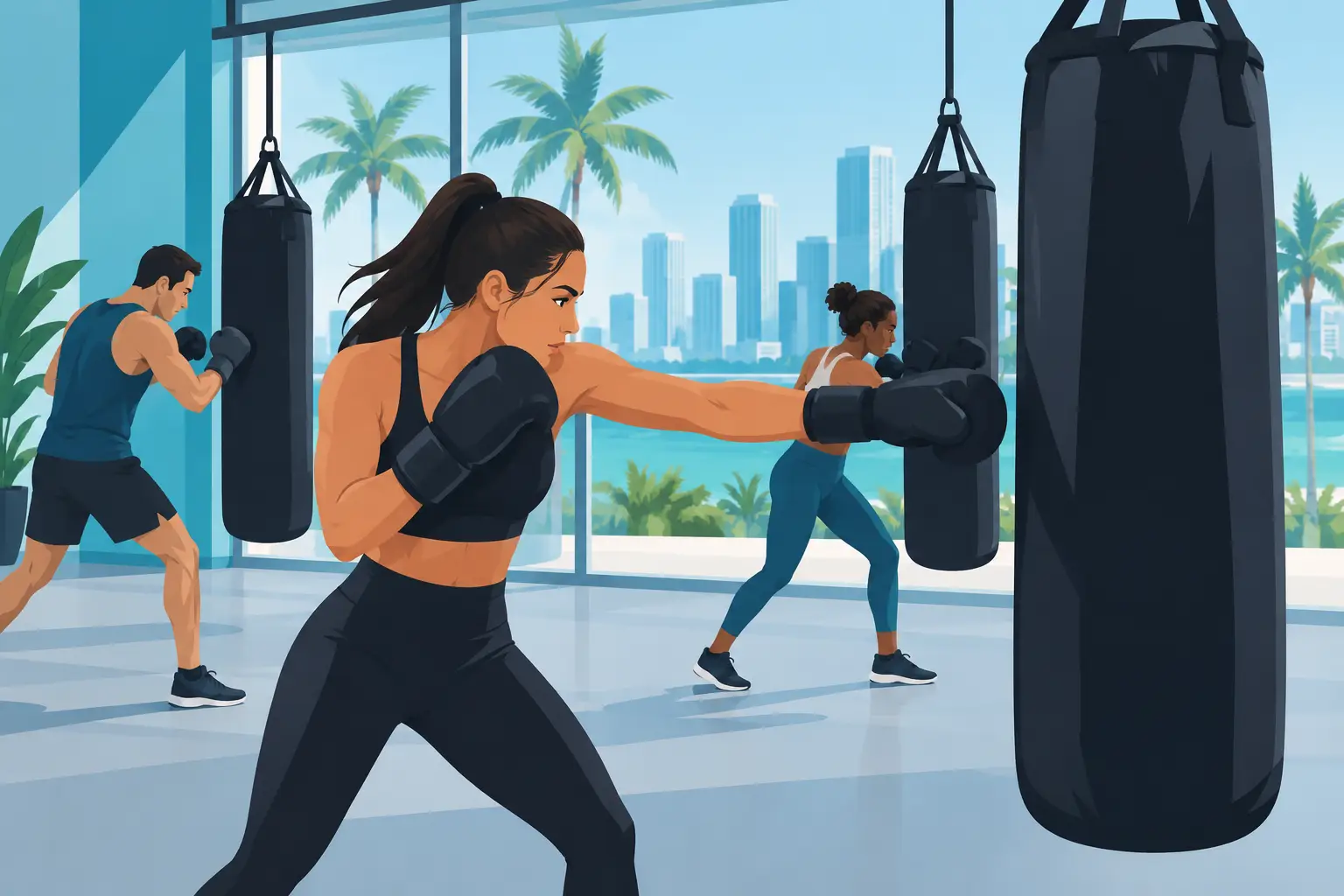
A heavy bag can give you a hard workout. It cannot tell you why your balance breaks when you throw a kick, when to cover after a combination, or how to stay composed when someone is moving in front of you. That is the difference between simply exercising and training at kickboxing classes Miami adults can rely on for real development.
For people around Little Havana, Allapattah, Downtown Miami, Midtown, and Wynwood, the right gym should offer more than loud music and exhausted legs. It should give you structured coaching, a clear path forward, and training that makes sense whether your goal is better conditioning, practical self-defense, stress relief, or competition.
What Quality Kickboxing Classes in Miami Should Teach
Real kickboxing begins with the basics, but “basic” does not mean easy or unimportant. A good first class teaches stance, posture, guard, footwork, and distance before asking you to throw hard combinations. Those details protect your joints, improve your power, and make every round on the pads or bags more productive.
You should learn how punches, kicks, knees, defensive movement, and positioning connect. A jab is not just an arm movement. It helps you manage range, set up a cross or kick, and create time to move safely. A round kick is not just a leg swing. It requires balance, hip rotation, a stable supporting foot, and a return to stance so you are ready for what comes next.
That technical foundation matters for beginners and experienced athletes alike. New students avoid building habits that are difficult to fix later. More seasoned strikers get the feedback needed to sharpen timing, defense, combinations, and ring awareness.
Fitness That Has a Purpose
Kickboxing is one of the most complete ways to train because it asks your entire body to work together. Pad rounds build cardiovascular conditioning. Bag work develops rhythm and repeatable power. Footwork challenges the legs and core. Drilling combinations develops coordination under fatigue, while controlled partner work teaches you to stay alert and calm.
The result is not just a high-calorie class. You build usable endurance. You notice it when stairs feel easier, when you recover faster between rounds, and when a stressful day does not drain you as quickly.
Still, no class should confuse fatigue with progress. Being soaked in sweat may feel satisfying, but good training has a reason behind each drill. One day may focus on clean boxing entries and exits. Another may emphasize kick defense, Dutch-style combinations, or conditioning rounds with specific targets. The work is demanding, but it is organized.
For members who primarily want fitness, that structure keeps training interesting and measurable. For aspiring fighters, it creates the discipline required to improve without skipping the fundamentals.
A Beginner Should Not Need Experience to Start
Many adults postpone their first class because they think everyone else will already know what they are doing. In a serious, respectful gym, that is not a problem. Beginners belong in the room.
Your first sessions should not begin with hard sparring or pressure to perform. You should be shown how to wrap your hands, stand correctly, strike pads safely, and listen to basic class commands. Coaches should explain the purpose of the drill, demonstrate it at a pace you can follow, then offer corrections that are specific enough to use right away.
The best beginner experience is challenging without being chaotic. You may feel awkward at first. Nearly everyone does. But after a few classes, combinations start to feel more natural, your confidence grows, and the gym becomes a place where you can focus fully for an hour.
If you are returning to training after time away, the same principle applies. Let the coach know about prior injuries, limitations, and your experience level. A smart program can scale intensity while helping you rebuild timing and conditioning.
What to Look for Before You Commit
A free introductory class is useful because it lets you judge the environment rather than guessing from photos or promises. Pay attention to how the coaches teach and how members treat one another. A clean facility and quality equipment matter, but the culture on the floor matters more.
Look for coaches who can explain technique clearly, correct people without showing off, and adapt instructions for different experience levels. Fight experience has real value when it is paired with the ability to teach. Coaches who have competed and trained seriously understand the details that hold up under pressure, from managing distance to recovering your guard after a strike.
It also helps to ask how the class schedule supports progression. A gym with foundations classes, pads and bags, advanced striking, clinch work, and drilling gives you room to grow. You should not be forced into an advanced room before you are ready, and you should not outgrow the program once you develop confidence.
For most adults, location and schedule are practical deciding factors. A great gym is only helpful if you can train consistently. Choose a place near home or work, with class times you can realistically attend two or three times each week. Consistency beats the occasional all-out session every time.
The Difference Between Training and Fighting
Kickboxing training can improve self-defense awareness, fitness, confidence, and emotional control. It can also prepare athletes for competition. Those goals overlap, but they are not identical.
A fitness-focused member may spend most of their time on pads, bags, movement, and technical partner drills. An aspiring competitor needs more rounds, defensive reactions, clinch skills where appropriate, strategic preparation, and carefully supervised sparring. Neither path is more valid. The important thing is that your coaches understand your goal and give you an honest path toward it.
Sparring, in particular, should be earned and controlled. It is a learning tool, not a toughness contest. Good sparring develops timing, composure, and decision-making. Poorly managed sparring creates injuries and sends good people out the door. A gym that respects safety is not soft. It is built for long-term progress.
Why Community Changes Your Results
Training is personal, but nobody gets better alone. The people around you affect whether you keep showing up when work gets busy, motivation dips, or progress feels slow. A strong striking community includes people at different levels who train hard without making the room hostile.
You should be able to share pads with an experienced athlete who helps you learn, then work beside another beginner who understands exactly how it feels to start from zero. Respect is visible in small moments: partners holding pads with attention, advanced students giving newer members space to learn, and coaches expecting discipline from everyone.
At Vice City Striking, the goal is to give central Miami adults that combination of authentic striking instruction and a welcoming room. Whether you want to get in shape, build confidence, sharpen your Muay Thai and kickboxing skills, or take fighting seriously, progress starts with learning the right way.
How to Get More From Your First Month
Come in with a simple goal: learn well enough to return. You do not need perfect coordination on day one. Wear comfortable training clothes, bring water, arrive a little early, and be ready to listen. As you settle in, training gear such as gloves and hand wraps becomes part of the routine.
Try to attend consistently instead of cramming every session into one ambitious week. Two or three classes weekly gives your body time to adapt and your mind time to retain the details. Between classes, basic recovery matters. Sleep, hydration, mobility work, and adequate nutrition all support the hours you spend on the mats.
Keep your attention on quality. Throwing a clean jab-cross with balance is better than rushing through ten sloppy combinations. Ask questions when you do not understand a correction. The willingness to slow down, learn, and repeat is what turns a beginner into a capable striker.
Book your free class, take the first step onto the floor, and give yourself permission to be new at something demanding. A month from now, the work you put in today can feel like stronger lungs, sharper technique, and a confidence that carries well beyond the gym.